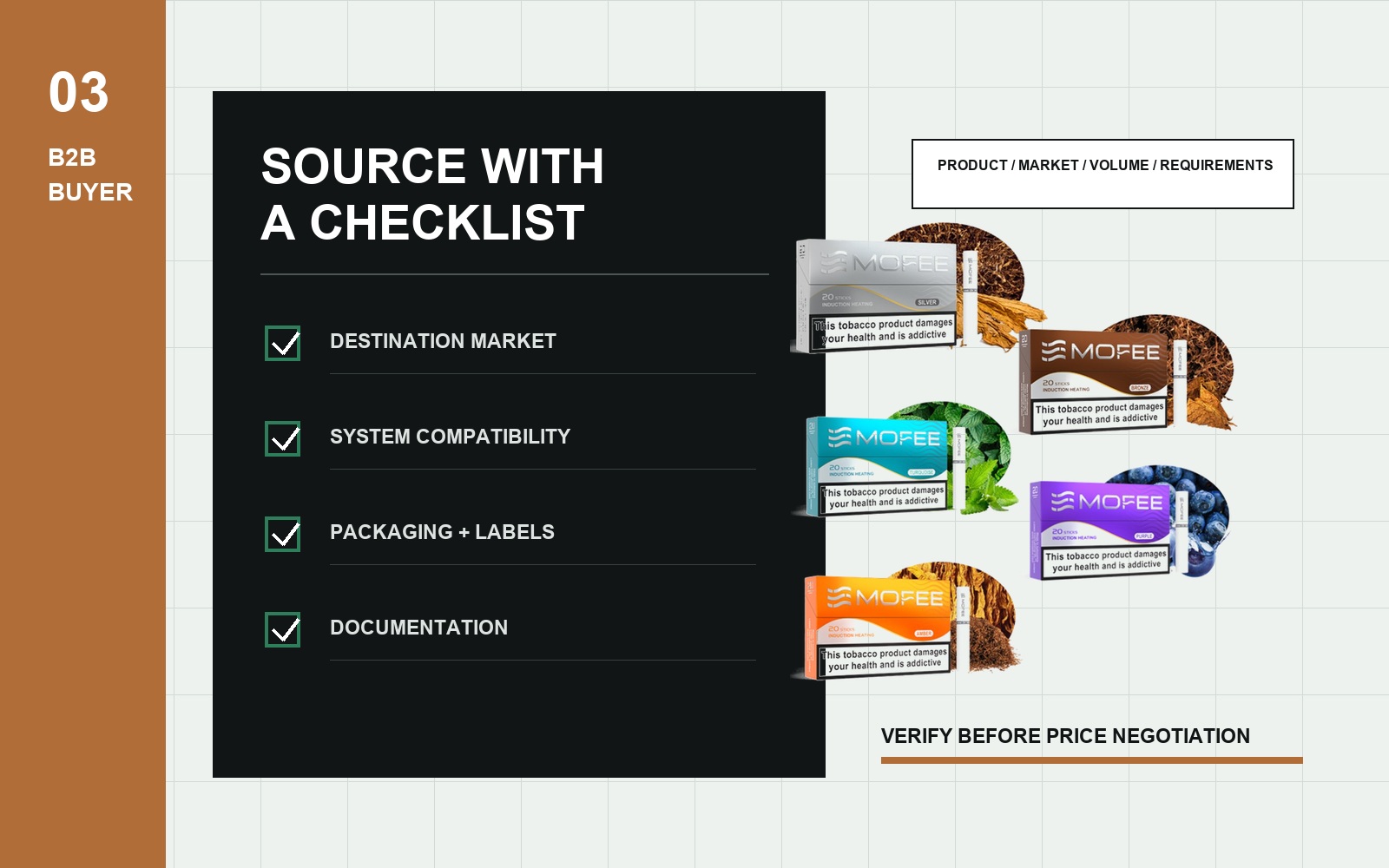
- Start with the destination market and product classification before choosing a pack variant.
- Treat compatibility, packaging versions, traceability, and documents as product requirements.
- A useful inquiry separates confirmed facts, open questions, samples, and local regulatory review.
An HNB inquiry often begins with a product image or a pack variant. A stronger process begins with the destination market, the complete device-and-consumable system, and the documents needed to review it. Use the gates below to create a clear record before comparing price or artwork.
Before you start
Write down four items before contacting a supplier: destination country or territory, intended channel, buyer type, and expected order range. Add whether you need devices, consumables, or a complete system. These details determine which questions are relevant and prevent a supplier from preparing a generic quotation that cannot be reviewed.
Gate 1 — Market and classification
Heated tobacco rules differ by country and can change over time. A product may be treated as a tobacco product, an electronic device, a combination of hardware and consumables, or another category. Before artwork, sampling, or launch planning, confirm whether the product can be imported, displayed, sampled, advertised, or sold in the intended market. Use qualified local counsel or a regulatory specialist for that determination; this checklist is not legal advice.
Record: market, channel, responsible reviewer, classification status, and unresolved questions.
Gate 2 — Complete product system
Record the device model and revision, heating method, consumable format, charging requirements, session operation, pack count, and intended compatibility. Ask the supplier to state the device–consumable relationship in writing. Similar dimensions or packaging do not prove that two products are interchangeable.
Request: specification sheet, compatibility matrix or statement, operating instructions, and production-equivalent samples.
Gate 3 — Manufacturer and traceability
Identify the legal manufacturer, production site, responsible importer or distributor, and the way a batch or lot is marked. Keep the sample, approved artwork, specification, and quotation tied to the same SKU and revision. If the supplier changes a component, pack format, or factory, ask what triggers a new review.
- Legal manufacturer and production-site details
- SKU, revision, batch or lot identification method
- Sample-to-production equivalence statement
- Change-control or notification process
Gate 4 — Packaging and claims
Review product name, tobacco or nicotine disclosures, health warnings, language, importer details, barcode, batch identification, pack count, and any market restrictions on colours or descriptors. Link the approved artwork to a specific SKU, destination, and version. Do not reuse a global pack file until the target market review is complete.
Keep construction facts separate from marketing claims. Statements about safety, reduced exposure, reduced risk, cessation, or official approval require product-specific and jurisdiction-specific review. FDA guidance distinguishes market authorization from a general statement that a tobacco product is safe or “FDA approved.”[FDA]
Gate 5 — Documents and reports
A certificate title alone does not establish that a product meets a destination requirement. Check the product identity, SKU, revision, issuing party, laboratory or method, date, and scope of every document. Mark each item as Confirmed, Pending, orNot applicable rather than treating “received” as “approved.”
- Product specification and bill-of-material summary appropriate to the inquiry
- Available test reports, method, laboratory, and report date
- Packaging artwork version and market destination
- Storage, transport, shelf-life, and device warranty information
- Any market or customs documents requested by the local reviewer
Gate 6 — Logistics and after-sales
Confirm carton and inner-pack configuration, storage conditions, lead time, minimum order quantity, sample policy, battery transport information where relevant, warranty scope, spare parts, and handling of damaged or non-conforming goods. These details often change the real commercial comparison more than the unit price alone.
Record: agreed incoterm or delivery basis, lead time, packaging units, warranty owner, and escalation contact.
Gate 7 — Ready-to-send inquiry brief
A complete first message can be short if it includes the right fields. Attach the product list or SKU references, then ask the supplier to reply against the same structure.
- Market: destination, channel, and intended launch stage
- Range: device, consumable, pack format, and requested variants
- Volume: trial order, expected monthly range, and forecast horizon
- Packaging: language, warnings, importer details, and artwork needs
- Documents: specifications, reports, storage, warranty, and customs requirements
- Samples: models, quantities, delivery address, and evaluation criteria
- Open points: questions that need local regulatory or technical confirmation
Do not move from “quote received” to “ready to launch” until the market, system, packaging, documentation, and logistics gates have an owner and a status.
Sources and scope
Public references support the regulatory and category cautions in this guide. They do not replace destination-market advice or product documentation.