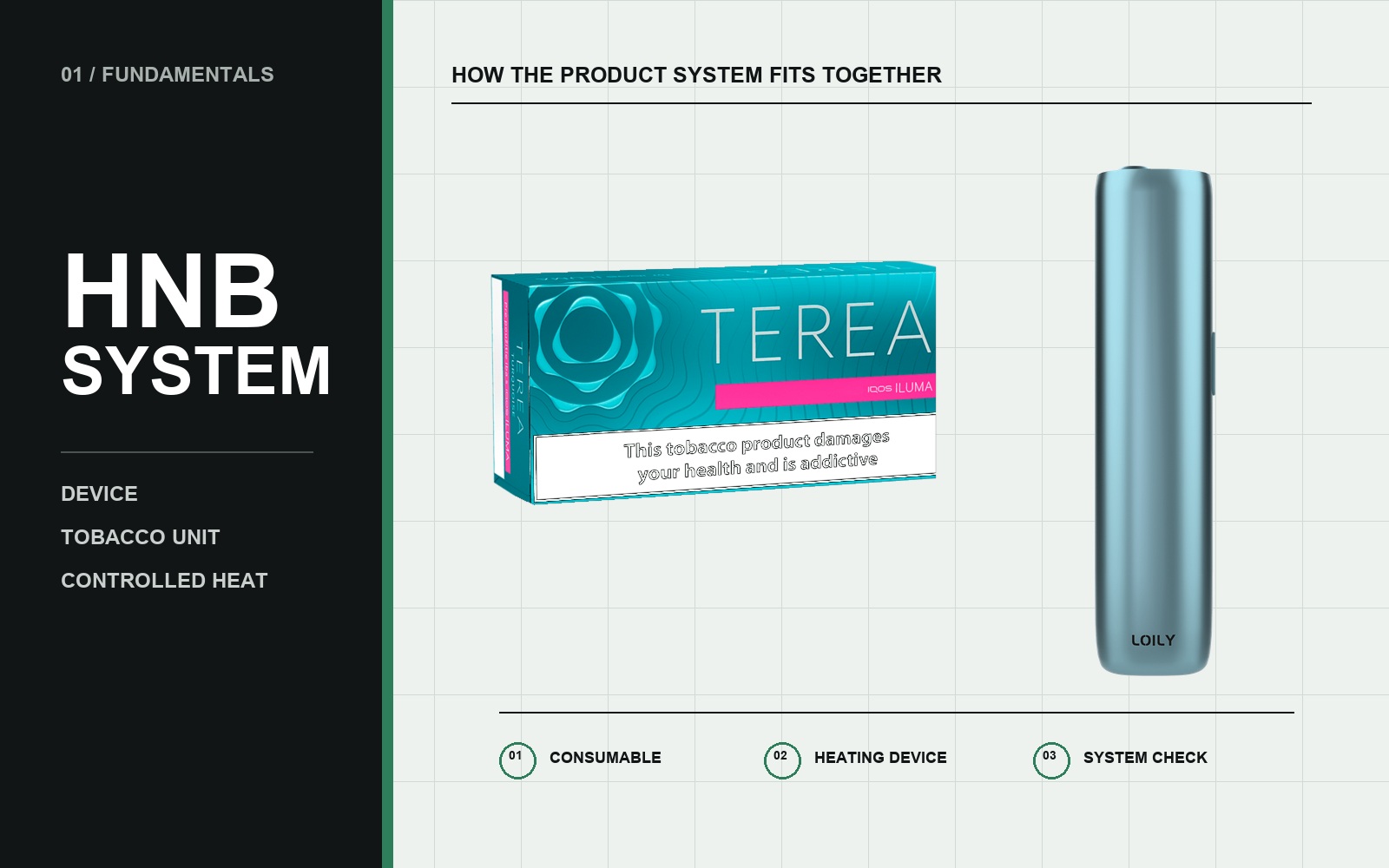
- An HNB product is a system: a tobacco-containing consumable, a heating method, and a defined device relationship.
- Category terms vary by market, so the product construction and intended operation should be documented.
- Compatibility, claims, and market eligibility must be confirmed for the exact SKU rather than inferred from appearance.
Heated tobacco products are often grouped under HTP, heated tobacco, heat-not-burn, or HNB. The labels are not interchangeable in every market or regulation. For a wholesale buyer, the useful starting point is the product system itself: what material is heated, which device performs the heating, and what documentation describes the intended combination.[FDA]
Terms vary by market
Public agencies use different terms when describing products that heat tobacco without the conventional process of lighting and continuously burning a cigarette. The FDA, for example, describes non-combusted cigarettes as products that generally heat dry tobacco to create an aerosol. WHO materials use heated tobacco products as a broad public-health category. These descriptions are useful for orientation, but they do not determine how a destination regulator will classify a particular product.[WHO]
Record the manufacturer’s product name, the technical description used in its specification, and the destination market’s classification separately. That simple separation prevents a catalogue label from being mistaken for a legal determination.
System anatomy
Most electronic HNB systems have at least two product layers. The first is a reusable or rechargeable heating device. The second is a purpose-made consumable containing processed tobacco or another tobacco-containing unit. The device applies heat according to a defined operating cycle; the consumable supplies the material used during that cycle.
For procurement, the relationship is more important than the silhouette. Record the device model, consumable format, insertion or attachment method, charging requirements, session controls, cleaning instructions, and pack configuration. A stick that looks similar to another stick is not evidence that it is interchangeable.
Common operating formats
HNB is a varied technical category. Public descriptions include direct electronic heating of a prepared tobacco stick or plug, indirect systems in which a generated aerosol passes through or interacts with tobacco, and other formats that use a separate heat source. These are category examples, not a claim that every format is present in a given supplier’s range.
- Direct electronic heating: a device heats a prepared tobacco unit in a defined chamber.
- Indirect or hybrid heating: heat or an aerosol is transferred through or around a tobacco-containing component.
- Other formats: the construction, heat source, and consumable should be taken from the product specification rather than a retail nickname.
Compatibility is a documented relationship
Compatibility should be confirmed in writing for the exact device and consumable models. Ask for the technical specification, intended operating instructions, and any compatibility matrix the manufacturer provides. Where practical, test production-equivalent samples rather than relying on a photograph or outer dimensions.
- Model names, revisions, and market-specific SKU codes
- Consumable dimensions, insertion depth, airflow, and heating position
- Operating cycle, charging requirements, and cleaning or maintenance instructions
- Written confirmation of the intended device–consumable combination
- Sample results and any differences between sample and production configuration
Responsible product descriptions
A professional B2B catalogue can describe construction, consumable type, pack count, device format, intended compatibility, and available documents. It should not turn “no combustion” or “heated” into a safety, cessation, reduced-risk, or approval claim. CDC states that heated tobacco products contain nicotine and are harmful; FDA also makes clear that authorization to market a tobacco product does not mean the product is safe or “FDA approved.”[CDC][FDA]
Keep factual copy and market-specific legal review in separate layers. The product page can say what the item is; the inquiry process should confirm what may be imported, displayed, promoted, or sold in the stated destination.
Questions for a supplier
Use these questions to turn a general product conversation into a reviewable record:
- What is the complete device and consumable SKU combination?
- Which document states the intended compatibility, and which revision does it cover?
- What pack format, language, warnings, and traceability marks are available for the target market?
- Which product specifications, test reports, storage notes, and warranty terms can be shared?
- Which statements are confirmed facts, and which require local regulatory review?
Sources and scope
Public references used for category orientation. They do not replace destination-market advice or product documentation.