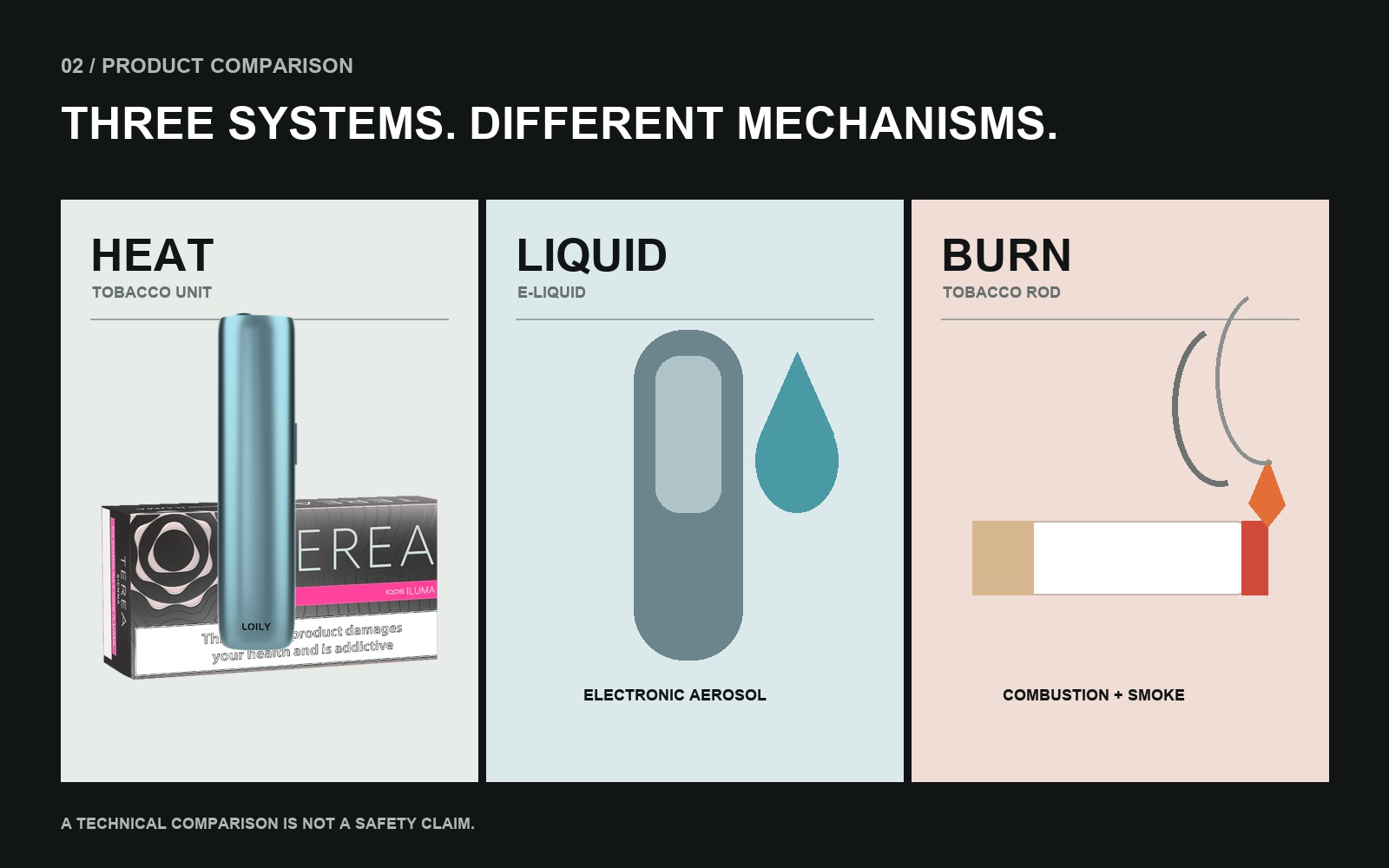
- The most useful comparison starts with what is heated or burned and which consumable the system requires.
- Similar-looking hardware can belong to different product categories and documentation paths.
- A technical comparison does not establish safety, reduced risk, cessation benefit, or market authorization.
HNB products, e-cigarettes, and combustible cigarettes may all deliver nicotine, but they use different consumables and processes. This guide compares those technical differences for catalogue organization and wholesale due diligence. It is not a safety ranking, a product recommendation, or a market authorization decision.[FDA]
Comparison scope
The comparison below uses product construction and operating method as its frame. Regulatory treatment differs by jurisdiction, and a destination authority may use definitions that do not map neatly onto a retail category name. Treat the table as a screening tool, then verify the exact SKU, documentation, packaging, and market requirements.
Quick comparison
| Feature | HNB / heated tobacco | E-cigarette | Combustible cigarette |
|---|---|---|---|
| Primary consumable | A prepared tobacco stick, plug, pod, or capsule, depending on the system | E-liquid held in a pod, tank, cartridge, or disposable unit | A tobacco rod wrapped in paper |
| Main process | Controlled heating of a tobacco-containing unit | Electronic heating of liquid ingredients | Lighting and sustained combustion |
| User hardware | Usually a matched electronic heating device | An electronic device or integrated disposable | No electronic device required |
| Output described by category | An aerosol from heated tobacco materials | An aerosol from heated liquid ingredients | Smoke and ash from burning tobacco |
| Compatibility | Often system-specific; confirm by model and revision | May depend on pod, coil, liquid, or device format | Not dependent on electronic device compatibility |
| Useful documents to request | System specification, compatibility statement, packaging and storage files | Ingredient, battery, device, packaging, and market documentation | Product, packaging, warning, batch, and market documentation |
What is heated or burned
The consumable is the clearest first distinction. FDA describes non-combusted cigarettes as products that generally heat dry tobacco to create an aerosol, while e-cigarettes heat an e-liquid. A combustible cigarette uses a tobacco rod that is lit and burned. This difference affects the product description, component list, testing file, customs paperwork, and possibly the legal category assigned by a regulator.[FDA]
Why appearance is insufficient
A slim electronic device may be designed for a solid tobacco stick, while a similar-looking device may use a liquid cartridge. Packaging color, shape, or a familiar market nickname cannot establish construction or compatibility. Ask for the product specification and intended-use statement, then keep the model, revision, and market SKU attached to the record.
Buyer implications
Category differences become practical requirements during sourcing. A buyer may need separate review paths for the consumable, electronics, battery transport, packaging warnings, language, traceability, storage, and after-sales support. The level of documentation should match the product system and the destination market; a generic certificate title is not a substitute for a document that identifies the relevant SKU and date.
- Catalogue: name the consumable and process precisely, with no category shortcuts.
- Operations: record compatibility, charging, storage, and pack configuration separately.
- Compliance: confirm classification, labels, warnings, and permitted claims locally.
- Commercial review: compare like-for-like SKUs, documents, lead times, and service terms.
Claims boundary
A technical comparison explains how products are constructed; it does not prove that one product is safe, safer, approved, or suitable for cessation. CDC states that heated tobacco products are harmful and contain nicotine. FDA guidance also distinguishes authorization to market a tobacco product from a general statement that the product is safe or “FDA approved.”[CDC]
Questions for a supplier
- What material is heated or burned, and what is the exact consumable format?
- Which device, pod, stick, coil, or accessory models are intended to work together?
- Which specification or compatibility statement identifies the exact revision and SKU?
- What packaging, warning, language, battery, storage, and traceability documents are available?
- Which statements are factual product descriptions and which require destination-market review?
Sources and scope
Public references used for technical orientation. They do not replace destination-market advice or product documentation.